This guide explains how to report fly‑tipping effectively from green spaces (especially footpaths) and what to do if your reports are not collected.
Our Guide to Successfully Reporting Fly-tipping…
When fly-tipping on local streets is reported, it is normally collected quickly by the London Borough of Waltham Forest (LBWF) team. They do a great job. However, fly-tipping in green spaces and around footpaths (‘grounds’) can be difficult to have removed, even when promptly reported, and leads to problems for our wildlife and to resident frustration. This is a particular problem around Cheney Row Park and the Folly Lane footpath area.
In 2025, we met with both the LBWF ‘Neighbourhoods North‘ and ‘Waste Contract Compliance’ department managers to unpick these problems. We also met the Community Engagement Officer for the borough’s waste contractor, FCC Environment. More recently, in the summer of 2026, we met the Director of Neighbourhoods for LBWF and received an update.
Here is our current understanding of the situation:
- Report fly-tipping
- How to report fly-tipping
- An important consideration for fly-tipping in green spaces
- Keep the receipt and REQ reference number.
- What if the fly-tipping is not collected?
- Disposing of household waste
- Keep reporting
Report Fly-Tipping
Items must be reported for removal.
➡️ Reporting is important to demonstrate the number of incidents occurring in the area and the number of residents concerned by it. This draws council attention and resources here. ✅
Bookmark the reporting link on your phone for when you are outside and see fly-tipping. Or search for ‘waltham forest report flytipping’ on your internet browser.
How to Report Fly-tipping
Report fly-tipping on the LBWF website, using this link. You will need to log in or register to do so.
➡️ Provide clear instructions on where the item is located. ✅
Don’t be vague. Assume the FCC Environment contractor does not know the local area. Locating items in this green area can be challenging. The system often identifies pins on the map as being located at ’65 Durban Road’ or in the Muslim Cemetery and not on the footpaths. To avoid confusion, please include detailed location information in your report. For example:
“From the bottom of Durban Road, turn right onto the Folly Lane footpath. The item is halfway between this point and the large pylon, on the right-hand side of the footpath”.
Include one or two photos, if possible ✅
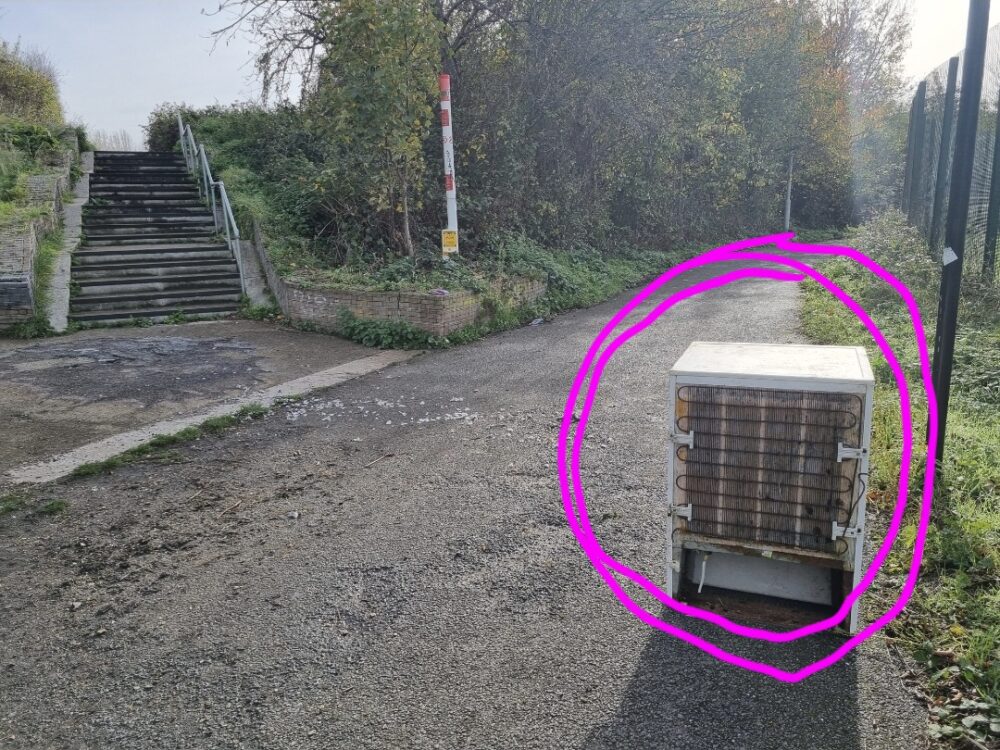
Use photos to clarify the item’s location (see example photo, below, showing the fridge in relation to the park steps).
If your photo is too large for their system to upload, take a screenshot of it and upload that instead.
Use what3words for precision ✅
The mobile app and/or webpage assigns a unique three-word code to every 3m square. It helps you share precise locations.
For example, https://w3w.co/quiz.sport.rather indicates where Durban Road meets the Folly Lane footpath.
Ideally, add a what3words link to your fly-tipping report.
An important consideration for fly-tipping in green spaces
➡️ Unfortunately, FCC Environment is only contracted for ‘streets’ and not for ‘grounds’.
This means their crew does not venture off the footpath into grassy areas, bushes or hedgerows to retrieve items. In order to be retrieved, items in these areas would first need to be moved onto the street or footpath and reported from there (see photo example below).
➡️ If you choose to do this: ✅
- Take great care!
- Use gloves and firm footwear.
- Lift heavy items with help and consider manual handling techniques.
- Watch out for broken glass, dog poop and other hazards.
- Do not move industrial waste or building materials (e.g. corrugated sheets or plasterboard) as these could contain asbestos and be classified as hazardous waste.
If the item is too heavy (e.g. a motorbike), email recyclingteam@walthamforest.gov.uk and request support. This request will be passed to the Neighbourhoods North team.
Keep the receipt and REQ reference number.
➡️ Keep the email receipt for the fly-tipping report and, in particular, note the REQ reference number.
This might be needed again.
What If The Fly-tipping Is Not Collected?
This happens. ☹️
➡️ Check the reason why the item was not collected.
In the summer of 2026, the LBWF reporting system was improved and it now sends an email response stating why the fly-tipping was not collected. This is a huge improvement. Previously, all report responses just stated ‘this is now complete’ even when it wasn’t. It only meant the case had been closed. The email response message now provides a reason why the fly-tipping was not removed, such as that the item could not be found or that it is on private property and therefore not LBWF responsibility.
Problems with the reporting map
This latter reason needs checking, as often fly-tipping on footpaths is picked up by the map as being located on private property, e.g. in the Muslim Cemetery, Walthamstow Academy, at a house on Durban Road, etc. There is still a problem with reporting of fly-tipping in green spaces due to how the map functions. LBWF knows there is a problem with the map detection system and is looking into it but the individual FCC contractors responding to the request probably do not. We hope for improvements here, with the map and with the communications to the contractors.
The new system is designed so that residents can respond to the email update with more information but this function is not working yet. We’re hoping for improvements here too.
➡️ Forward your notification email (and REQ) to the LBWF recycling team inbox
If your fly-tipped item is not collected within a few days, or you receive notification to say that it hasn’t been collected, and you feel it should be, forward your notification email (with the REQ) to recyclingteam@walthamforest.gov.uk. Provide additional details, concisely, and ask them to follow up. This draws attention to the issue to LBWF itself.
Unfortunately, our experience is that emails to this inbox are not responded to. It is still an important step but bear this in mind.
➡️ Contact a Higham Hill Ward Councillor
If contacting the recycling team inbox does not resolve the incident, there is a problem. Forward the email chain with a clear REQ number and a brief summary of the issue (i.e. fly-tipping not collected and no satisfactory response received from follow-up communication to the recycling team) to the Higham Hill ward councillors.
Our ward councillors know fly-tipping is a big concern in Higham Hill and in this part of Higham Hill. Cllr. Karen Bellamy assisted with our previous meeting with LBWF Waste Contract Compliance Manager. We have also met with the new Cllr. Louise Ashcroft and explained the situation to her. Councillors can contact department managers directly and pass your query on. These people are incredibly busy but also helpful and responsive.
Disposing of Household Waste
40% of fly-tipping incidents are estimated to be carried out by rogue traders rather than individuals.
Keep Britain Tidy urges the public to ask anybody they hire to remove waste to show a ‘waste carrier registration number‘. This number (or the business name) can then be quickly checked on the Environment Agency’s website or by calling 03708 506 506 – option 1 then 2.
Thank You and Keep Reporting
We all need to work together to keep the Folly Lane footpath and surrounding areas free from fly-tipping.
Fly-tipping is a social and environmental national concern that communities are fighting all around the country.
Thank you for your time and dedication to this cause. Please keep reporting, it genuinely makes a difference.
Last updated: 16th October 2026
Originally written 30th October 2025